Priced from the documents
A root canal on a molar costs $500.00. And $553.28. And $1,346.40.
Same procedure code, same year, three published payer schedules in one country. This site is what happens when you stop looking for an average and start reading the documents.
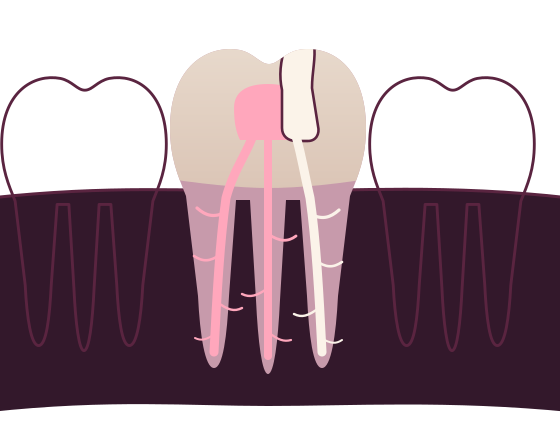
- enamel
- dentine
- pulp and its canals
- the treated canal
Why this site exists
Search for the price of a root canal and you will find confident averages with nothing underneath them. We went looking for the source of those numbers on 24 September 2026 and could not find one: no free, public, primary document publishes a national retail price for this procedure in the United States. The dental profession's own fee survey is a paid publication, and its file would not open for us at all.
So this site does the only honest thing left. It prices root canal treatment from documents that genuinely exist and that anyone can open — three published payer fee schedules, each one a public commitment about what will be paid, each one linked below with the day we read it.
They do not agree. On a molar, the same procedure code is allowed at $500.00 in Pennsylvania, $553.28 in Montana and $1,346.40 on the Washington State corrections schedule. The gap between the smallest and the largest is a factor of 2.7, and it is not a mistake. It is what a price looks like when nobody is obliged to publish one.
What you can actually use this for
Not for knowing what you will be charged — no document here can tell you that, and a practice in private hands sets its own fees. What these schedules give you is the shape of the bill, and the shape holds whoever is paying:
- Which tooth it is changes the number before anything else. A molar has more canals than a front tooth, they are narrower and they curve, and every schedule prices that.
- The root canal line is written "excluding final restoration" on all three documents. The crown that follows is a separate code, and on the schedules that price both it is roughly half the combined total.
- The cheapest step is the first one. A problem-focused exam and one X-ray runs $59.28 to $144.00 across the three, and until somebody has done it nobody knows whether the tooth needs this treatment at all.
Take a quote apart along those lines and it stops being one number you cannot argue with.
What this site will not do
It will not tell you what is wrong with your tooth. Nobody with a dental licence has read a word of this site, we have never pretended otherwise, and the question of whether a particular tooth can be saved is answered by examining it and taking an X-ray of it — not by reading.
It also prints no figure it could not trace. There is no lifespan for a treated tooth here, because we could not find one from a source we could open and date. There is no success rate, for the same reason. There is no average American price. Where a number is missing from this site, the page says so and says why, which is more useful than a plausible guess.
One molar, three published schedules
Molar
The three documents everything here is priced from
Not one of them is a retail price list. Each is a payer saying what it will pay a dentist who has agreed to its terms, and each is a file you can open yourself.
Pennsylvania
Pennsylvania Medical Assistance Program — Medical Assistance Program Dental Fee Schedule. a state Medicaid dental schedule, effective 1 August 2026. Read on 24 September 2026. Open the document.
Montana
Montana Healthcare Programs — Fee Schedule — Dental Services, January 1, 2026. a state Medicaid dental schedule, effective 1 January 2026 (line rates effective 1 July 2025). Read on 24 September 2026. Open the document.
Washington DOC
Washington State Department of Corrections — DOC Endodontic Fee Schedule. a corrections health schedule for one specialty, effective 1 January 2026. Read on 24 September 2026. Open the document.
The chapters
Ten of them. Each opens with its answer and says where the answer came from.
Anaesthetic and Sedation for a Root Canal
Local anaesthetic is the default and is included in the procedure — it has no separate line on any schedule we read. Sedation is a different thing entirely, billed by the quarter hour, and it is worth knowing what that costs before you say yes.
Do You Need a Crown After a Root Canal?
On the schedules that price both, the crown is roughly half of the total bill — and the endodontists' own guidance says it depends mostly on which tooth it is. Back teeth generally get one; front teeth often do not.
Endodontist or General Dentist: Who Does Root Canals
Both do. An endodontist is a specialist with at least two further years of training after dental school, and by their own association's figure only about three per cent of dentists are one.
When a Root Canal Fails: Retreatment, and What It Costs
Redoing the treatment is a normal, coded, priced procedure — and on both schedules that list it, it costs more than doing it the first time. Here is what the codes say and what the options are.
Lowering Your Odds of Ever Needing a Root Canal
There is no method that guarantees it, and anyone selling one is selling something. What there is: a window in which early decay can be stopped, and a set of dull habits that keep teeth inside that window.
Pain After a Root Canal: What Is Ordinary and What Is a Phone Call
Soreness for a few days is what the sources describe. Severe pain, pressure, or pain still going after a few days is the line where every source we read says to ring the person who did the treatment.
Five things people ask before anything else
Why does this site not print one average price for a root canal?
Because we could not find one published by a source we could open and check. On 24 September 2026 we looked for a free, primary, national US figure and found none — the ADA's own fee survey is a paid publication and its file would not open for us. What we found instead were payer fee schedules: documents that say, line by line, what a particular payer will pay. Three of them are on the cost page, with links, and they disagree by a factor of 2.7 on the same molar. Printing an average of numbers we cannot see would have been easier and would have been fiction.
Is a root canal painful?
We will not tell you how it will feel, because we cannot know. What can be said is what the documents say. The NHS page on the treatment, reviewed on 3 October 2025, says you will usually be given a local anaesthetic, so you will be awake but will not feel any pain. The American Association of Endodontists, which is the endodontists' own professional body, says the pain people associate with the procedure is usually caused by the infection rather than by the treatment. Both are worth knowing, and neither is a promise about your appointment.
Does this site tell me whether I need a root canal?
No, and it would be dishonest to try. Nobody with a dental licence has read this site, and the decision rests on things that cannot travel down a wire: what the tooth looks like, how it responds to testing, and what an X-ray shows. The chapters here describe the signs that tend to send people to a dentist and the questions worth asking once you are in the chair. They stop there on purpose.
Who pays for this site?
Three links, all of them on the cost page and nowhere else. Two are discount dental plans, which are memberships rather than insurance, and one is an appointment-booking service. A note above them says they are commercial, and the disclosure page names the programmes we turned down: a plan whose own affiliate page publishes no terms, and a teledentistry service the fleet brief would have allowed on the emergency chapter, which is exactly where it does not belong.
Are the prices here what I will be charged?
Almost certainly not, and the cost page says so in its first paragraph. Every dollar figure on this site is an allowed amount from a named payer's schedule — what that payer pays a dentist who has agreed to it. A private practice sets its own fees and is not bound by any of these documents. The reason to read them anyway is that they show the shape of the bill: which line is the canal, which is the crown, and how much of the total arrives after the root canal is finished.